Kurdistan Region of Iraq Residency Guide (2026): Types, Costs, Sponsors and Work Permits
A step-by-step guide to residency in the Kurdistan Region of Iraq: residency card types, the sponsor (kafeel) system, blood test and security clearance, official 2021 fee schedule (still current as of spring 2026), work permits, investor and property residency, and overstay fines with the 2026 grace window.
Published
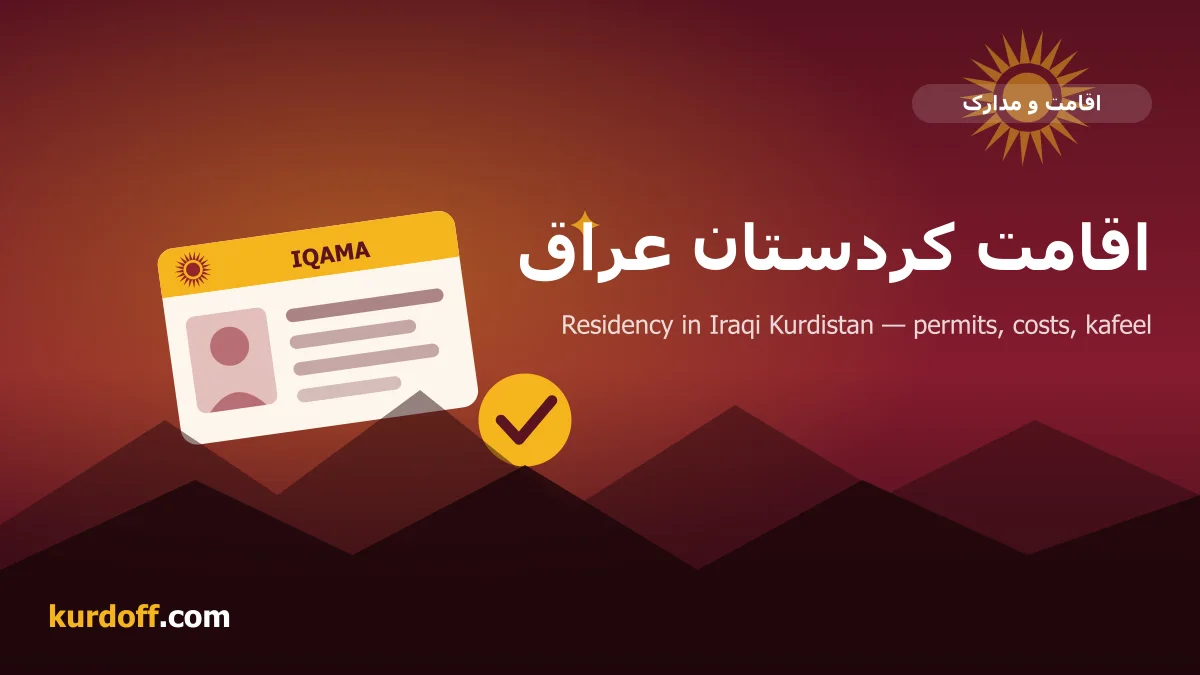
A residency card (iqama) in the Kurdistan Region of Iraq is issued by the residency directorates of Erbil, Sulaymaniyah and Duhok under the Region's Ministry of Interior; its legal basis is Iraq's Foreigners' Residence Law No. 76 of 2017 and Directive No. 1 of 2021. The standard card is valid for six months or one year and, on the company route, renewable annually up to 9 years. Iranians enter the Region without a prior visa and get a 30-day window; to stay longer they must convert the entry visa into a residency card before it expires: under the official 2021 fee schedule — still the basis of the KRG's official service pages as of spring 2026 — that means 300,000 IQD for conversion plus 150,000 IQD card issuance and a 25,000 IQD administrative fee. In this Kurdoff guide we walk through residency types, sponsors, the process and documents, dated costs, work permits, investor residency and fines, step by step.
Types of Residency in the Kurdistan Region
According to the KRG's official services catalogue (services.gov.krd, residency directorate pages, archived versions from March and April 2026), the main routes to a residency card are:
- Residency through residency-and-visa companies (the common work route): the same company that issued the visit visa must obtain the residency card; an employment contract, Form 18 (A and B) and Form 20 or a Ministry of Labour letter are required. Valid for 6 months or 1 year, renewable annually up to 9 years; the company assumes full legal and financial responsibility for the person.
- Residency through government institutions: for foreigners employed by KRG institutions; valid for 6 months or 1 year.
- Residency with a personal guarantor (kafeel): a private employer — for example, of a domestic worker — becomes the guarantor by completing Forms 15 and 16, and the work contract must be approved by the Labour Directorate.
- Student residency: for foreign students aged 18 and above with a support letter from their educational institution; valid for 6 months or 1 year.
- Residency through international organizations and NGOs: the person's family members also receive residency cards with support from the Social Care Directorate.
- Family/spouse residency: for couples where one partner is Iraqi and the other is foreign; a marriage certificate is required for family reunification and file transfer.
- Investor residency (announced 20 June 2025): a 3-to-5-year residency with approval from the Kurdistan Board of Investment, or a 1-to-3-year residency for buying a residential unit worth at least USD 50,000 in approved investment projects; the spouse, children under 18 and parents receive residency of the same duration.
How Does the Sponsor (Kafeel) System Work?
Nearly every route requires a guarantor: an Iraqi citizen holding a Kurdistan Region information card, a registered company/employer, or a residency-and-visa company. Under Article 1, Clause 10 of Directive 1/2021, each individual may sponsor at most 3 foreigners (members of one family are exempt from the cap). Members of the internal security forces, the Peshmerga, and security or federal employees may not act as sponsors.
Iranian Entry to the Region and the 30-Day Window
According to Persian-language travel sources (accessed 2026-07-17), Iranians do not need a prior visa to enter Erbil, Sulaymaniyah or Duhok and can stay up to 30 days; the window resets with each exit and re-entry. These details have not yet been confirmed directly by an official KRG source and should be verified before travel; in practice, a 30-day entry stamp is issued at the Iran-Kurdistan land borders (Bashmaq, Tamarchin, Haji Omaran, Parvizkhan). One crucial point: according to UNHCR Iraq, the Region's entry visa and residency card are valid only in the three Kurdistan governorates and are not valid for Baghdad or Iraq's central and southern governorates; violating this risks detention or deportation.
Step-by-Step Process for Getting a Residency Card
- Step 1 — Enter on a visit visa or entry stamp; the explicit official requirement: the residency card must be applied for before the visa expires.
- Step 2 — Register at the governorate's residency directorate (Erbil, Sulaymaniyah or Duhok); the applicant's name is sent electronically to the Central Public Health Laboratory.
- Step 3 — Blood test at the Central Public Health Laboratory: screening for HIV, hepatitis B and C, malaria and bilharzia; the fee is 31,500 IQD, with an electronic result in 48 hours. The Erbil laboratory address: opposite Jalil Khayat Mosque, 60 Meter Road.
- Step 4 — Security clearance (Asayish): an interview at the local Asayish headquarters about occupation, political affiliation and family ties, plus approval from the neighbourhood mukhtar.
- Step 5 — Ministry of Labour interview (personal-sponsorship/worker route only): the employer and the foreign worker attend an interview at the Labour Directorate.
- Step 6 — Pay the fees at the accounting office, have documents scanned, complete fingerprinting (biometrics) and receive the residency card.
Required Documents
- Passport with at least 6 months' validity, plus a copy of the latest entry stamp into Iraq/the Region
- Proof of residence support (a letter from the neighbourhood mukhtar)
- A support letter from the employer, institution or sponsor, together with the work contract (on the work route)
- 1 photo (for renewal: the previous residency card plus 1 photo)
- Official forms depending on the route: Forms 15 and 16 for personal sponsorship; Form 18 (A and B) and Form 20 for the company route
- Minimum age of 18 and a clean criminal record (no disgraceful act)
Where to go (working hours 8:30 to 14:30): in Erbil, Park (32) next to the passport building (07515192466); in Sulaymaniyah, Narges neighbourhood, behind the Binayi petrol station (05033190574); in Duhok, Shindokha (07503765276). Official processing times: government institutions 5 to 7 days, residency-and-visa companies 7 to 10 days, personal sponsorship 3 to 5 days; local lawyers' experience for renewals is also about one week (accessed 2026-07-17).
Residency Costs — With an As-Of Date on Every Figure
All rates below follow the official fee schedule of Directive No. 1 of 2021, still listed as current on the official services.gov.krd pages as of spring 2026; health insurance and the work permit were added from February 2025:
- Converting a visit visa to a residency card for nationals of visa-free countries (including Iran): 300,000 IQD — once, at first issuance (2021 schedule, official archived version 2026-03-20)
- Conversion for nationals of countries requiring a prior visa: 1,000,000 IQD — once (2021 schedule)
- Residency card issuance: 150,000 IQD per issuance + application administrative fee: 25,000 IQD (2021 schedule)
- Card renewal (all types): the same 150,000 + 25,000 IQD; local lawyers report the practical total paid at the counter as 175,000 IQD (accessed 2026-07-17)
- Fine for late renewal or lacking a valid residency document: 20,000 IQD per day, from the day after expiry (2021 schedule, still in force in 2026)
- Blood test: 31,500 IQD, with an electronic result in 48 hours (official pages, 2026 archived versions)
- Iraqi health insurance for residency applicants: 375,000 IQD per year — mandatory since February 2025 (Fragomen report, 2025-02-26)
- KRG work permit: 110,000 IQD (about USD 84) — mandatory since February 2025 (Fragomen and Lexis Middle East, February 2025)
- KRG e-visa (if needed or chosen): 100,000 IQD — this figure appears only in an unofficial source (Wikipedia, accessed 2026-07-17) and needs official confirmation
Work Permits in the Kurdistan Region
A residency card alone does not grant the right to work: since September 2024, the federal government and the KRG have declared that no foreigner may work without a work permit from the Ministry of Labour and Social Affairs, and that an entry visa does not mean the right to work. From February 2025, the work permit became mandatory in the Region at a cost of 110,000 IQD. The main conditions:
- Labour market test: the employer must advertise the job for 30 days on the Ministry of Labour website and prove that no qualified local worker is available (Fragomen/Lexis, February 2025)
- The employer must present tax and social security clearance certificates
- The work contract must be approved by the Labour Directorate; on the personal-sponsorship route, an in-person interview of employer and worker takes place at the Ministry of Labour
- Annual health insurance of 375,000 IQD for the residency applicant (mandatory since February 2025). Important note: the temporary work-entry ban of April 2025 covered 5 nationalities, but Iran is not on that list (Rudaw, 2025-04-29)
Investor and Property Residency
On 20 June 2025, the KRG Ministry of Interior announced two new pathways: a 3-to-5-year residency for foreign investors approved by the Kurdistan Board of Investment (BOI), and a 1-to-3-year work residency for buyers of a residential unit worth at least USD 50,000 in approved projects; in both, the spouse, children under 18 and parents receive residency of the same duration, and both are renewable. Note: the implementation details — including the exact investor-approval criteria — are not yet clear, so check with the Board of Investment or a local lawyer before any financial decision.
Company registration is also possible: under the Kurdistan Region Investment Law (No. 4 of 2006), a foreign investor may own 100% of a project's capital and benefit from tax exemptions. Electronic business registration has been running since 9 January 2023 on the business.digital.gov.krd system, and the trade-name issuance fee is 50,000 IQD. The minimum capital reported by unofficial sources is 1,000,000 IQD and should be confirmed with the official authority.
Fines, the 2026 Grace Window and Common Pitfalls
The base fine for overstaying or failing to renew is 20,000 IQD (about USD 14-16) per day. An important ongoing development: because Iraq's airspace was closed for roughly 40 days (from 28 February 2026), the KRG Ministry of Interior announced on 27-28 April 2026 that residency violators need pay only 25% of accumulated fines — a 75% waiver. Rudaw reported the window as 90 working days while KPMG stated it ends on 26 July 2026; since the sources conflict on how the deadline is counted, verify the exact end date with the residency directorate. Before this, a full fine waiver applied to expirations after 28 February through 30 April 2026. Meanwhile, enforcement has tightened: from the start of 2025 to 5 November 2025, Iraq deported more than 35,000 residency violators, and the penalty for illegal entry or defying a deportation order is up to one year in prison or a fine of 500,000 to 1,000,000 IQD.
- Always act before expiry — the first application before the visa ends, and renewal before the card expires; in personal sponsorship, the late fine is the employer's/sponsor's responsibility.
- Kurdistan residency is valid only in the Region: crossing checkpoints toward Kirkuk, Mosul or Baghdad on a KRG card risks detention (UNHCR Iraq).
- The same-company rule: the residency card must be obtained by the same company that issued your entry visa.
- Do not pick an ineligible sponsor: members of the security forces, the Peshmerga and federal employees may not sponsor, and each individual sponsor may guarantee at most 3 people (except members of one family).
- Do not count on a blood-test exemption: according to Fragomen, the previous age-based exemptions have been suspended and in practice everyone must be tested; this point needs official confirmation.
- The re-entry ban period after deportation is not officially specified; before travelling again, be sure to get legal advice from the residency directorate or a local lawyer.
The Region's residency rules changed several times between 2024 and 2026; before taking any step, verify the latest fees and conditions with the governorate residency directorate or a reputable local lawyer.
Frequently Asked Questions
Do Iranians need a visa to visit Erbil and Sulaymaniyah?
For a short stay, no: Iranians enter the Region with a valid passport and get up to 30 days; the window resets on exit and re-entry (travel sources, accessed 2026-07-17). Since sources report the details differently, check the up-to-date situation before travelling.
What should I do to stay longer than 30 days?
The visit visa must be converted into a residency card before the window ends. Under the official 2021 schedule (current as of spring 2026): 300,000 IQD conversion for visa-free nationals (including Iran) + 150,000 IQD card issuance + a 25,000 IQD administrative fee.
How long is the KRG residency card valid, and how long can it be renewed?
The standard card is valid for six months or one year and, on the company route, renewable annually up to 9 years; investor residency (June 2025) runs 3 to 5 years and property residency 1 to 3 years, both renewable.
What is a kafeel (sponsor), and who can be one?
The kafeel is your legal and financial guarantor: an Iraqi citizen holding a Region information card, a registered employer/company, or a residency-and-visa company. Security forces and Peshmerga members may not sponsor, and each individual may sponsor at most 3 foreigners (members of one family excepted).
What does the residency blood test cover, and how much does it cost?
Screening for HIV, hepatitis B and C, malaria and bilharzia at the Central Public Health Laboratory (Erbil: opposite Jalil Khayat Mosque, 60 Meter Road); the fee is 31,500 IQD with an electronic result in 48 hours.
How does the Asayish security clearance work?
After the application is filed, the applicant is referred to the Asayish; the interview at the local headquarters covers occupation, political affiliation and family ties, and approval from the neighbourhood mukhtar is also required.
How long does it take to issue the residency card?
According to the official pages, 3 to 10 days depending on the route: government institutions 5 to 7, residency-and-visa companies 7 to 10, and personal sponsorship 3 to 5 days.
What is the fine if my residency or visa expires?
20,000 IQD per day of delay. In 2026, only 25% of accumulated fines are collected until the end of the grace window; KPMG reports the window ending 26 July 2026 while Rudaw reports 90 working days, so verify the exact date with the residency directorate.
Can I travel to Baghdad, Najaf or Karbala with a KRG residency card?
No; according to UNHCR Iraq, the KRG residency card is valid only in the three governorates of Erbil, Sulaymaniyah and Duhok and is not valid for Iraq's central and southern governorates. Crossing checkpoints on a KRG card risks detention or deportation.
Can I get residency by buying a home in Erbil?
Yes; since June 2025, buying a residential unit worth at least USD 50,000 in approved projects grants, with Board of Investment approval, a 1-to-3-year work residency that also covers the spouse, children under 18 and parents. The implementation details are not yet clear; consult a local lawyer before buying.