Shanidar Cave
Shanidar Valley (Mergasur)
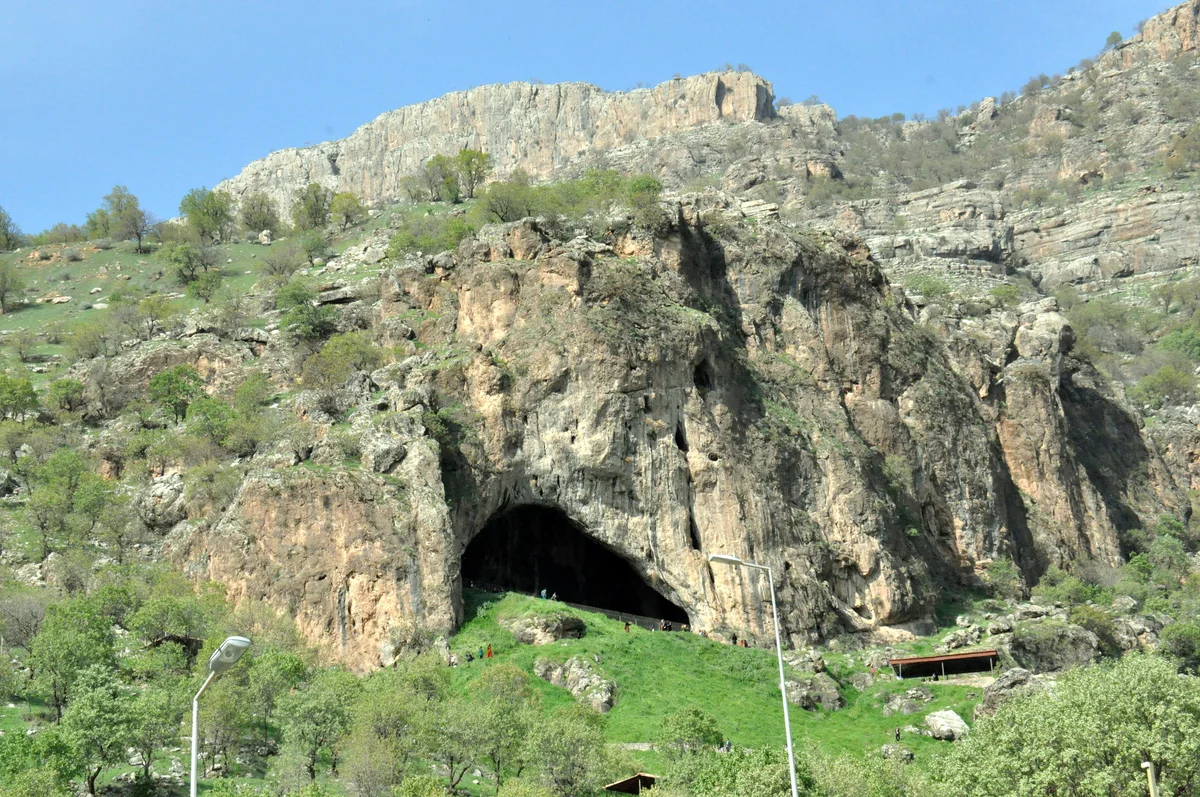
The famous archaeological cave on Bradost Mountain in the Zagros — where the remains of ten Neanderthals and the much-debated "flower burial" were found.
About
Shanidar Cave lies on the slopes of Bradost Mountain in the Zagros range, in Erbil Governorate. Ralph Solecki's excavations of 1951–1961 uncovered the remains of ten Neanderthals dating from roughly 35,000 to 65,000 years ago. Its most famous find is the "flower burial": clumps of flower pollen beside one skeleton, first read as evidence of a ritual burial with flowers, though most scholars now attribute the pollen to burrowing rodents and bees. Renewed Cambridge-led excavations have continued since 2015.
Ralph Solecki's excavations and the ten Neanderthals
American archaeologist Ralph Solecki first tested the site in 1951 and returned with Smithsonian Institution and Iraqi Antiquities Directorate support for systematic seasons in 1953, 1956–57 and 1960. Inside a cave mouth roughly 25 m wide and 8 m high, his team found a Mousterian layer with stone points, side-scrapers and flakes alongside wild-goat and tortoise bones — and, within it, the remains of ten Neanderthal men, women and children. Shanidar 1, an elderly male, had survived a crushed eye socket, a withered or amputated right arm, hearing loss and healed leg fractures — injuries so severe that he could hardly have survived without help from others. Shanidar 2 and 5 were killed by rockfalls; Shanidar 3 bears a rib wound some researchers read as the oldest known case of interpersonal violence in the human fossil record, and lived for weeks afterward. Fragments from at least four more individuals (Shanidar 6–9, including an infant) turned up while excavating Shanidar 4 — whose own burial is the subject of the next section. A tenth individual, represented only by leg and foot bones, was recognised only in 2006 while a Smithsonian researcher was re-examining Solecki's animal-bone collection. Higher up, separate from the Neanderthal layer, Solecki's team also found a much younger Proto-Neolithic cemetery of roughly 35 people, about 10,600 years old — a reminder that Shanidar was used, on and off, across tens of thousands of years.
The 'flower burial' debate: Shanidar 4
Shanidar 4, an adult male, was found lying on his left side in a loosely curled position. Palynologist Arlette Leroi-Gourhan reported dense clumps of pollen from several flowering plants — including yarrow, cornflower, ragwort, grape hyacinth and hollyhock — in soil samples taken around the skeleton. Solecki and Leroi-Gourhan proposed in the 1960s–70s that flowers had been deliberately placed with the body, reading it as evidence of Neanderthal ritual and even speculating that Shanidar 4 might have been a kind of healer, since several of the identified plants have traditional medicinal uses. The 'flower burial' became one of the most widely repeated images of Neanderthals as capable of grief and symbolic behaviour. More recent work has challenged the pollen's origin rather than the burial itself: researchers, including archaeologist Paul Pettitt, argue that the pollen clumps are better explained by a burrowing rodent — the Persian jird, which caches seeds and flowers in its tunnels — and by pollen carried in by nesting solitary bees, rather than by people laying flowers on the grave. This does not overturn the idea that Shanidar Neanderthals treated their dead deliberately — the careful positioning of later finds such as Shanidar Z (see below) still points that way — but the specific 'flowers in the grave' image is now treated with real scepticism among specialists, and Kurdoff presents it here as a debated, not settled, interpretation.
Renewed excavations since 2015: the Cambridge project and Shanidar Z
Since 2015, the Shanidar Cave Project — led by Professor Graeme Barker of the University of Cambridge, in partnership with the Kurdistan Directorate of Antiquities — has reopened part of Solecki's original trench with modern excavation and dating methods. The team, which includes Dr Emma Pomeroy studying the human remains, found further fragmentary Neanderthal bones (informally numbered Shanidar 11 and 12) and, in 2018, a well-preserved partial upper skeleton nicknamed 'Shanidar Z'. Announced in 2020, Shanidar Z is thought to be an adult, possibly a woman in her mid-40s or older, who died more than 70,000 years ago; her body appears to have been placed in a hollow that was deliberately shaped in the sediment, which the team reads as further evidence of intentional mortuary treatment. In 2024, the crushed skull was reconstructed and used to build a facial reconstruction of Shanidar Z, presented in the BBC/Netflix documentary 'Secrets of the Neanderthals'. The project has also drawn on Solecki's own excavation archive, now held by the Smithsonian's National Anthropological Archives, to re-examine the original 1950s–60s finds with today's techniques.
Geography and getting there
Shanidar Cave opens on the slopes of Bradost Mountain, part of the Zagros range, in Mergasur district of Erbil Governorate, near the Great Zab river valley — roughly 2,100 ft (about 640 m) above sea level. The Kurdistan Regional Government's Board of Tourism lists it among Mergasur district's history-and-heritage sites. Neither the tourism board's page nor other official sources we found publish visiting hours, an entry fee, or a visitor centre for the cave: unlike Erbil Citadel or Amna Suraka, Shanidar remains primarily a research excavation on a mountainside rather than a developed museum site. Travellers who want to see it should treat it as a rural, off-the-beaten-path destination in Mergasur district and check locally — for example with the district's tourism office or a local guide — before making the trip, rather than expecting a ticketed monument.
Where the Neanderthal remains are today
The fate of Solecki's finds is split between two countries. Shanidar 3's skeleton, together with casts of several other individuals, is held by the Smithsonian's National Museum of Natural History in Washington, D.C., and displayed in its Hall of Human Origins. Some accounts have raised concern that other original remains kept in Iraq (Shanidar 1, 2 and 4–8) could have been affected by the instability that followed the 2003 invasion. Even so, museum photographs taken in 2019 show human remains labelled 'Shanidar I' and 'Shanidar II' on public display in the Iraq Museum's Pre-History Gallery in Baghdad, and a Mousterian-period stone tool from the Shanidar excavation is on display at the Sulaymaniyah Museum — so at least some of the original material, or finds directly associated with it, remains accessible in Iraq today. The newer discoveries from the Cambridge-led dig — Shanidar Z and the fragmentary Shanidar 11–12 — are held by Kurdistan's Directorate of Antiquities and the project team while study continues.
Photo gallery
Watch
Frequently asked questions
- Can visitors go inside Shanidar Cave?
- The KRG Board of Tourism lists Shanidar Cave among Mergasur district's heritage sites, but neither that page nor other official sources publish visiting hours, an entry fee or a visitor centre. It remains primarily a research excavation on a mountainside, not a ticketed museum, so check locally — for example with the district tourism office or a local guide — before planning a visit.
- Where are the Shanidar Neanderthal remains kept today?
- Shanidar 3's skeleton and casts of several other individuals are held by the Smithsonian's National Museum of Natural History in Washington, D.C. Photographs from 2019 show remains labelled Shanidar I and Shanidar II on display at the Iraq Museum in Baghdad, and a stone tool from the excavation is displayed at the Sulaymaniyah Museum. The newer finds from the Cambridge-led dig — Shanidar Z and fragments 11–12 — are held by Kurdistan's Directorate of Antiquities while study continues.
- What is the 'flower burial' and is it still believed today?
- It refers to clumps of flower pollen found around the Shanidar 4 skeleton in the 1960s, first read as evidence that flowers were deliberately placed in the grave. Many researchers today are sceptical of that specific reading: they argue a burrowing rodent (the Persian jird) and nesting bees better explain how the pollen got there. This doesn't overturn the broader idea that Shanidar's Neanderthals treated their dead deliberately, but the 'flowers in the grave' image itself is now debated, not settled — Kurdoff presents both sides here rather than only the popular version.
- Who is excavating Shanidar Cave today?
- Since 2015, the Shanidar Cave Project has been led by Professor Graeme Barker of the University of Cambridge in partnership with Kurdistan's Directorate of Antiquities. Dr Emma Pomeroy, also of Cambridge, leads the study of the human remains the team has found, including Shanidar Z.
- What did the renewed excavations discover?
- In 2018 the Cambridge-led team found a well-preserved partial upper skeleton, announced in 2020 as 'Shanidar Z' — an adult who died more than 70,000 years ago and appears to have been laid in a deliberately shaped hollow. In 2024 researchers reconstructed her crushed skull and built a facial reconstruction, featured in the documentary 'Secrets of the Neanderthals'. The team also found further fragmentary remains, informally called Shanidar 11 and 12.
Sources for this profile
- https://en.wikipedia.org/wiki/Shanidar_Cave
- http://bot.gov.krd/erbil-province-mirgasor/history-and-heritage/shanidar-cave
- https://www.arch.cam.ac.uk/research/projects/current-projects/shanidar-cave-project
- https://www.arch.cam.ac.uk/research/projects/current-projects/shanidar-cave-project/importance-shanidar
- https://www.cam.ac.uk/stories/shanidarz
- https://www.youtube.com/watch?v=HrtyOkb1CVM