Amna Suraka Museum (Red Security)
Sulaymaniyah
The former Ba'ath security headquarters and prison in Sulaymaniyah, converted in 2003 into a memorial museum for its victims.
About
From 1979 to 1991 Amna Suraka was the northern headquarters of the Ba'ath regime's General Security Directorate, where Kurdish dissidents were imprisoned and tortured. It fell to the Peshmerga during the 1991 uprising and opened in 2003 as Iraq's first museum documenting Ba'ath-era crimes. Its Hall of Mirrors — 182,000 shards for the victims of the Anfal campaign and 4,500 lights for the destroyed villages — together with the preserved cells and bullet-scarred walls, make it one of the most moving sites in the region.
From secret security post to the Red Prison (1979 to 1991)
Not long after Saddam Hussein seized power in Iraq in July 1979, the Ba'ath regime decided to build a General Security Directorate (Da'irat al-Amn) in every Iraqi province. Sulaymaniyah was the first province to get one; the building was designed in East Germany and construction was completed in 1985, with the prison cells added as the final phase. At first, the regime lied to the public that the compound was merely an 'agriculture directorate.' But from 1979 to 1991, the same compound served as the northern headquarters of the Iraqi Interior Ministry's General Security Directorate, where students, Kurdish nationalists and other political opponents — including Arabs and Christians — were imprisoned. Numerous accounts report that many detainees were tortured and sexually abused there; its name, 'Amna Suraka,' comes from the building's red colour.
The 1991 uprising and the fall of the security compound
During the Battle of Sulaymaniyah, part of the wider Kurdish uprising against Saddam Hussein in the spring of 1991 after the Gulf War, Iraqi security forces made this compound their final stronghold. After roughly a two-hour assault, Peshmerga forces succeeded in taking the entire compound. Accounts put the number of security personnel killed in the takeover between 700 and 800, though some conscripted soldiers were later pardoned through the mediation of Massoud Barzani, then leader of the Kurdistan Democratic Party. The fall of this stronghold ended eleven years of its use as a detention and torture centre in Sulaymaniyah, turning it into a symbol of the uprising's victory in the city.
From prison to museum: opening in 2003
After years standing untouched as a war memorial, Amna Suraka opened in 2003 as Iraq's first museum documenting Ba'ath-era crimes. Hero Ibrahim Ahmed, wife of Iraq's then-president Jalal Talabani, played a key role in turning the site into a formal human-rights documentation museum. Its core funding came from the Patriotic Union of Kurdistan (PUK), with support from the Talabani family and the Qaiwan Group; admission is free to the public and it's open six days a week. Today the museum is run by director Ako Gharib, who has expansion plans: a Kurdish carpet museum displaying around 1,200 handmade carpets from Kurdistan and neighbouring regions, and a genocide museum focused on the Kurdish and Yazidi genocides.
The Hall of Mirrors and what you see in the museum today
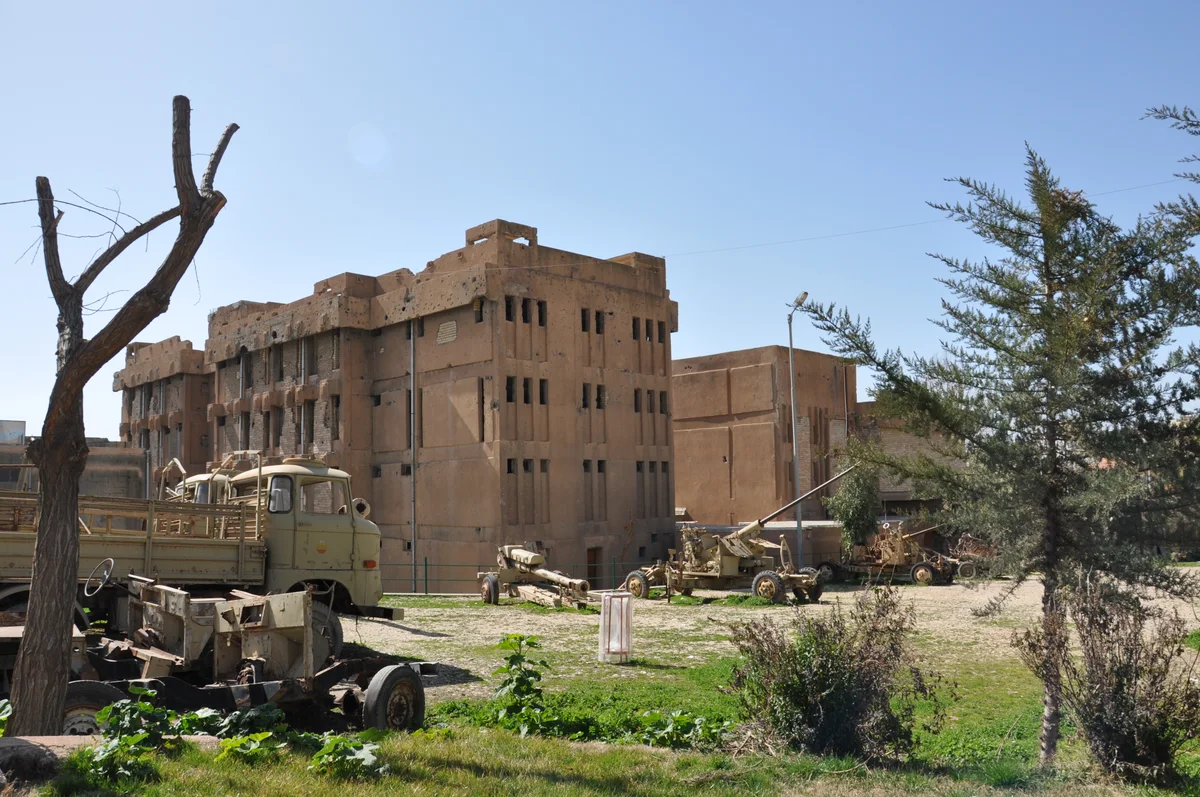
Amna Suraka's most famous section is the Hall of Mirrors: a space lined with around 182,000 mirror shards, one for each Kurd killed during the Anfal operations, and 4,500 lights representing Kurdistan's destroyed villages. Alongside it, the original prison cells with their metal doors and barred windows remain intact, and visitors can walk into them; on some cell walls, texts, dates, anti-regime slogans and even pencil sketches once left by prisoners are still visible today. Outside, military equipment captured from the former Iraqi army — including a T-55 tank, an MT-LB armoured vehicle mounted with a ZU-23-2 anti-aircraft gun, a BMP-1 infantry fighting vehicle, and a 122mm D-30 howitzer — is displayed beside the bullet-riddled building. The exterior walls still bear clear marks of the bullets and shrapnel from the 1991 battle, forming part of the visit itself.
Visiting today and the museum's future
Amna Suraka is located in the Goizha neighbourhood of Sulaymaniyah and today ranks among the city's biggest tourist attractions. Several independent travel sources report free admission with hours of roughly 9 a.m. to 5 p.m., six days a week (closed Fridays) — but since no official government or museum page states these hours with certainty, it's worth confirming locally before you go. According to Kurdistan Chronicle, the museum hosts around 59,000 visitors a year, including school and university students, roughly 3,000 foreign tourists, and diplomatic delegations. Visiting the Hall of Mirrors and the prison cells can be a heavy, emotional experience; many travel accounts describe it as one of Sulaymaniyah's most moving yet essential destinations for understanding Kurdistan's recent history.
Photo gallery
Frequently asked questions
- What was Amna Suraka before it became a museum?
- From 1979 to 1991 this compound was the northern headquarters of the Iraqi Interior Ministry's General Security Directorate under Saddam Hussein — a building designed in East Germany and completed in 1985, first falsely presented as an agriculture directorate. Students, Kurdish nationalists and other political opponents were imprisoned and tortured there.
- What happened here during the 1991 uprising?
- During the Battle of Sulaymaniyah, Iraqi security forces made this compound their final stronghold. After a roughly two-hour assault, the Peshmerga captured it; accounts put security personnel deaths between 700 and 800, though some conscripted soldiers were later pardoned through Massoud Barzani's mediation.
- What is the Hall of Mirrors?
- A section of the museum lined with around 182,000 mirror shards commemorating Kurds killed in the Anfal operations, and 4,500 lights representing Kurdistan's destroyed villages — one of Amna Suraka's most moving and best-known sections.
- Is there an entrance fee, and what are the visiting hours?
- Admission is free to the public. Several independent travel sources report the museum is open six days a week (closed Friday) from roughly 9 a.m. to 5 p.m.; but since no official government page states these hours, it's worth confirming locally before your visit.
- What do visitors see in the museum today?
- The Hall of Mirrors; the original prison cells, with texts and sketches left by prisoners; and outside, captured military equipment from the former Iraqi army — including a T-55 tank, an MT-LB fitted with an anti-aircraft gun, a BMP-1 fighting vehicle and a D-30 howitzer — beside walls still riddled with bullet marks from the 1991 battle.
Sources for this profile
- https://en.wikipedia.org/wiki/Amna_Suraka
- https://en.wikipedia.org/wiki/Battle_of_Sulaymaniyah
- https://www.atlasobscura.com/places/amna-suraka-prison
- https://kurdistanchronicle.com/b/3392
- https://theamargi.com/posts/from-torture-center-to-memorial-amna-suraka-chronicles-saddams-brutality-in-slemani
- https://www.visitiraq.iq/copy-of-kurdish-textile-musuem